Washington’s cold incoming water makes a tankless unit work harder in winter than the spec sheet suggests, which is why sizing matters so much for Federal Way homes near the I-5/320th Street interchange. Greener Cleaner sizes every tankless installation for your coldest months, not an average day.
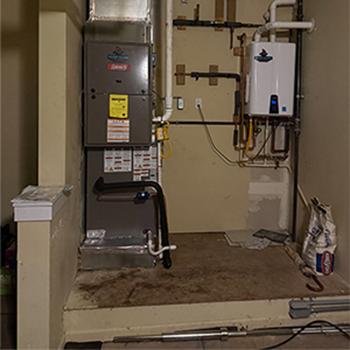 Tankless water heaters sit where plumbing, gas, and venting overlap, which is exactly where Greener Cleaner’s cross-trained Federal Way technicians are strongest (Plumbing Lic. GREENCH741OS, HVAC Lic. GREENCH769NG). We check the gas supply, vent routing, and water conditions up front, so the quote reflects the real scope of the installation, not a best-case guess.
Honest answers for Federal Way homeowners, before you spend a dollar.
Tankless tends to make the most sense in a few situations: a household that runs out of hot water with a tank, a home where floor space matters, a family planning to stay long enough to recoup the higher upfront cost, or a property with a gas line that can be upsized. It’s a weaker fit when gas capacity is limited, venting is difficult, or hot water use is very light. In Federal Way, where a mix of single-family homes built from the 1970s through today is common, the answer varies between a compact home near the I-5/320th Street interchange and a larger property near Steel Lake. We’ll look at your actual setup and tell you which side of the line you’re on.
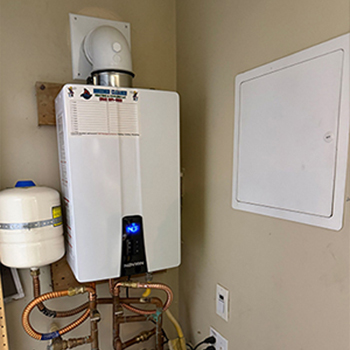 The biggest question with tankless is whether your home can support it. A tankless unit needs a gas line sized for a much higher burn rate than a tank, a vent path to the outside, and a water supply with enough flow to keep the burner firing. For Federal Way homes near Dash Point, we check each of those before recommending a model, and we size the unit to the temperature rise you actually need in winter rather than the number on the box. That prevents the classic tankless disappointment: a unit that handles one shower but struggles when the dishwasher and a second bathroom join in.
If you’re planning a remodel or addition in Federal Way, it’s the ideal time to look at tankless. Moving the water heater to a wall near the bathrooms can shorten pipe runs and cut the wait for hot water. We coordinate with your contractor on gas, venting, and plumbing so the water heater doesn’t hold up the rest of the project.
Plenty of Federal Way homeowners come to us after a tankless installation elsewhere left them with weak flow or error codes. Most of those problems trace back to sizing, gas supply, or venting, which is why we check all three before recommending a unit, and why we’re comfortable servicing tankless systems we didn’t install.
We also serve nearby communities including Bellevue, Bothell, and Burien. Dispatch is coordinated across these areas, so a technician already working nearby can often reach you faster than a scheduled appointment would suggest.
New toilet, bidet retrofit, or a stubborn repair — Greener Cleaner’s Tukwila team is ready. Call (206) 210-4113.