Switching to a tankless water heater is a bigger decision than swapping one tank for another, and Puyallup homeowners deserve a plumber who will say honestly whether it fits their home. Greener Cleaner installs and services tankless systems with the same licensed crew that handles gas lines, venting, and water heater repair.
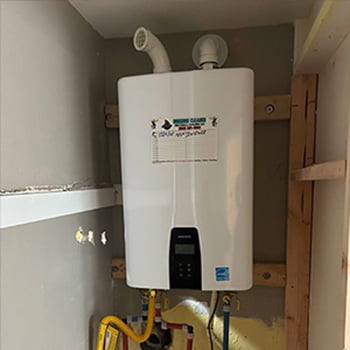 A tankless unit is only as good as the installation behind it. Our licensed, bonded, and insured Puyallup technicians (Plumbing Lic. GREENCH741OS, HVAC Lic. GREENCH769NG) size the unit to your household’s peak demand, confirm the gas line can support it, and test flow and temperature before leaving, so the first hot shower is proof it was done right.
Honest answers for Puyallup homeowners, before you spend a dollar.
Tankless tends to make the most sense in a few situations: a household that runs out of hot water with a tank, a home where floor space matters, a family planning to stay long enough to recoup the higher upfront cost, or a property with a gas line that can be upsized. It’s a weaker fit when gas capacity is limited, venting is difficult, or hot water use is very light. In Puyallup, where a mix of historic valley homes and newer hillside subdivisions is common, the answer varies between a compact home near the Washington State Fairgrounds and a larger property near Downtown Puyallup. We’ll look at your actual setup and tell you which side of the line you’re on.
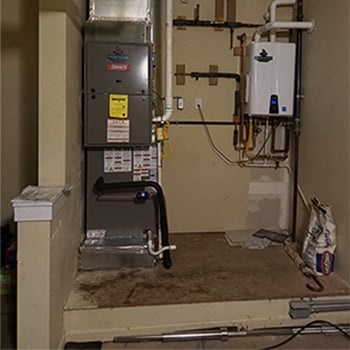 Tankless water heaters heat water only when you open a tap, which eliminates standby heat loss and the limited capacity of a storage tank. The tradeoff is that they demand more from your home: a gas line large enough for a high-burn-rate appliance, proper venting, a condensate drain for high-efficiency models, and a unit sized for how many fixtures run at once. For Puyallup homes near the Puyallup River, we inspect each of those before quoting, so a conversion doesn’t surprise you with hidden costs. After installation we flush and program the unit, confirm temperature at the farthest fixture, and explain maintenance, including the annual descaling that keeps a tankless unit efficient.
One local detail worth knowing in Puyallup: many homes near the Washington State Fairgrounds were built with a water heater closet or garage corner sized for a 40- or 50-gallon tank, and a wall-mounted tankless unit frees that space for storage. We measure the existing space, the gas meter location, and the likely vent route during the estimate, so you can see exactly what the finished installation would look like before you decide.
Plenty of Puyallup homeowners come to us after a tankless installation elsewhere left them with weak flow or error codes. Most of those problems trace back to sizing, gas supply, or venting, which is why we check all three before recommending a unit, and why we’re comfortable servicing tankless systems we didn’t install.
We also serve nearby communities including Bothell, Burien, and Des Moines. Dispatch is coordinated across these areas, so a technician already working nearby can often reach you faster than a scheduled appointment would suggest.
Find out whether tankless fits your home, and what it really costs.