As Redmond households near the Sammamish River Trail look to save space and cut standby energy loss, tankless water heaters have moved from a niche upgrade to a mainstream request. Greener Cleaner handles the full job: sizing, gas and venting upgrades, installation, and startup.
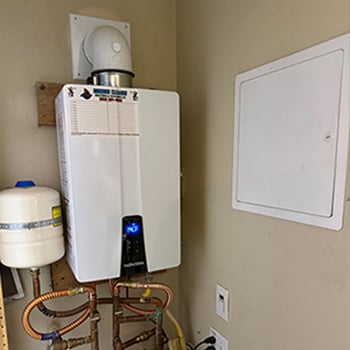 Every tankless installation in Redmond is completed by a licensed, bonded, and insured technician (Plumbing Lic. GREENCH741OS, HVAC Lic. GREENCH769NG). Because our team works on both plumbing and gas-fired equipment, we evaluate the whole system, including gas line size, venting path, and condensate drainage, rather than just mounting a new unit on the wall. You get a written quote that covers those upgrades before work begins.
Honest answers for Redmond homeowners, before you spend a dollar.
Tankless tends to make the most sense in a few situations: a household that runs out of hot water with a tank, a home where floor space matters, a family planning to stay long enough to recoup the higher upfront cost, or a property with a gas line that can be upsized. It’s a weaker fit when gas capacity is limited, venting is difficult, or hot water use is very light. In Redmond, where a mix of established neighborhoods and newer high-density housing near tech campuses is common, the answer varies between a compact home near the Sammamish River Trail and a larger property near Downtown Redmond. We’ll look at your actual setup and tell you which side of the line you’re on.
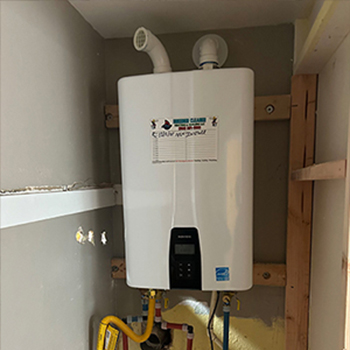 Tankless water heaters heat water only when you open a tap, which eliminates standby heat loss and the limited capacity of a storage tank. The tradeoff is that they demand more from your home: a gas line large enough for a high-burn-rate appliance, proper venting, a condensate drain for high-efficiency models, and a unit sized for how many fixtures run at once. For Redmond homes near Marymoor Park, we inspect each of those before quoting, so a conversion doesn’t surprise you with hidden costs. After installation we flush and program the unit, confirm temperature at the farthest fixture, and explain maintenance, including the annual descaling that keeps a tankless unit efficient.
If you’re planning a remodel or addition in Redmond, it’s the ideal time to look at tankless. Moving the water heater to a wall near the bathrooms can shorten pipe runs and cut the wait for hot water. We coordinate with your contractor on gas, venting, and plumbing so the water heater doesn’t hold up the rest of the project.
A tankless water heater is a long-term purchase, which is why Greener Cleaner’s Redmond plumbers lead with honest sizing and a complete quote rather than a low number that grows once the walls are open. We’ll explain the maintenance a tankless unit needs, including annual descaling, so the efficiency you paid for lasts for years.
We also serve nearby communities including Everett, Federal Way, and Kent. Dispatch is coordinated across these areas, so a technician already working nearby can often reach you faster than a scheduled appointment would suggest.
Find out whether tankless fits your home, and what it really costs